How to Create a Personal Brand on LinkedIn (From 4 Founders Who Actually Did It)
Learn how to build a personal brand on LinkedIn from the four Kleo co-founders who actually did it. Positioning, voice, content, and the systems that make it stick.
If you're looking to grow your personal brand then you can't be sleeping on LinkedIn.
In 2023, Kleo co-founder Jake Ward wrote a post about using AI to redirect 3.6 million organic visits from a competitor.
The SEO industry called it the SEO Heist. Journalists covered it. Google’s CEO, Sundar Pichai, even commented on it. The post racked up hundreds of comments, thousands of reposts, and put Jake on the map overnight.
One post. One idea rooted in genuine expertise. And it helped launch his personal brand.
The key insight from Lara’s framework: a solid personal brand is based on education, not just storytelling. You need to be useful in the market. If nobody would pay for what you know, you don’t have a personal brand. You have a diary.
Sounds harsh but it's true.
Everything that follows in this article builds on that foundation.
- First, get clear on the value you bring.
- Then learn how to communicate it in a way that sounds like you
- Connects with the people who need to hear it.
How to Build Your Personal Brand on LinkedIn
Building a personal brand on LinkedIn is not about hacks or tricks. It is about doing seven things well, consistently, over a long enough period for them to compound.
Here is how each one works.
1. Define your positioning
Positioning on LinkedIn is the answer to three questions:
- What do you actually know? Not what you want to be known for someday. What you know right now, from real experience.
- Who needs to hear it? A specific type of person with a specific type of problem. “Everyone” is not an audience.
- What makes your perspective different? Ten other people might know the same thing. The difference is how you see it, shaped by your specific experience and point of view.
This is your positioning. It’s the foundation everything else is built on. Without it, content creation is a guessing game.
Personal branding in practice: How Rob started
At 25, Rob Hoffman was bartending at a dive bar in Toronto. He saved $10,000, moved into a $50 per month apartment in the barrios of Medellin (cracked concrete walls, no hot water, next door neighbours who stole motorcycles), and tried building every business imaginable from that apartment. A fitness brand. Niche affiliate sites. Nothing worked.
Then he got a writing gig at a startup. He stopped drinking. He grabbed the wheel. He sold half a million dollars for the company that year. Doubled it the next. Eventually built an SEO agency that crossed $1 million in annual revenue. Today, he’s the CEO of three profitable tech companies.
Rob’s positioning on LinkedIn isn’t “SEO expert.” It’s “someone who built companies from nothing, failed repeatedly, and kept going.” That’s why his content resonates. His audience doesn’t just want tips, they want the perspective of someone who’s been in the trenches.
The takeaway: positioning is about finding the intersection of what you know and the lived experience that makes your take on it worth reading. Nobody else has Rob’s story. And nobody else has yours.
If you want to find out how to create your personal brand online, join the next Kleo Cohort.
2. Study the platform before you post
The biggest mistake people make when creating a personal brand on LinkedIn is posting before they understand what works.
They sit down, write something that feels good, hit publish, and get 47 views. Then they wonder if personal branding is even worth it.
It is. But not if you skip the research.
Go and look for inspiration. Who's winning on LinkedIn and why?
(Of course if you're on Kleo, you can save this to your swipe file)
How Lara Acosta reverse-engineered LinkedIn
In 2022, Lara was unemployed. She had no audience, no following, and no idea what she was doing. But she had time.
So she locked herself in a room until she could figure out how to make LinkedIn work for her.
Instead of posting immediately, she spent hours every day studying the platform. She analyzed which posts traveled, which creators consistently grew, and which content structures seemed to trigger the algorithm.
She found a unique angle, doubled down on it, and within months had built one of the most visible personal brands on LinkedIn. Lara has earned the LinkedIn Gold Top Voice badge and made the Forbes 30 Under 30 list. Entrepreneur UK and Forbes featured her on how she turned content into companies.
That research phase is the step most people skip. And it’s the reason most people’s content falls flat.
How to do your own research
Pick five to ten creators on LinkedIn whose audience looks like the one you want to build. For each creator, find the posts that performed significantly better than average. Screenshot them.
Then study each high performing post with three questions:
- What is the structure? How does it open? How is the body organized? How does it close? Is it a story? A framework? A controversial take? A list?
- Why does it connect? Is it the specificity? The vulnerability? The practical value? Figure out the emotional or intellectual mechanism behind the engagement.
- How can you apply this to your own ideas? You’re not copying content. You’re adopting structural choices and applying them to your own knowledge.
One week of this research will teach you more about LinkedIn than six months of random posting.
“AI can speed up execution, but it can’t replace the thinking behind great content. The creators who win with AI are the ones who have already developed the skill and use the tools to amplify it.” Lara Acosta, Kleo co-founder
3. Write like yourself, not like everyone else
This is where most personal brands on LinkedIn go to die.
Not because people stop posting but because they start sounding like AI chatbots and get lost in the noise.
Many creators read a few posts from big creators, absorb the patterns, and start unconsciously mimicking the tone, the cadence, even the sentence structures. The result is content that feels vaguely familiar but completely forgettable. It reads like it could have been written by anyone or by ChatGPT.
Content that could have been written an AI chatbot or by anyone else will never build a personal brand.
Voice and point of view (POV) are the thing that makes people stop scrolling when they see a name. And it’s not something you can simply copy from someone else. It’s something you uncover by writing enough that the performance falls away and the real version of you shows up.
A lesson from Kleo's founders on developing your personal brand
All four Kleo co-founders write on LinkedIn and yet none of them sound the same.
- Lara Acosta writes like a mentor having a direct conversation. Warm, structured, and grounded in frameworks she’s actually tested.
- Rob Hoffman writes like he’s telling you a story from a bar. Raw, honest, and unapologetic.
- Cam Trew writes like a builder sharing his working notes. Technical, precise, quietly confident.
- Jake Ward’s content is data-heavy, direct, and very outcome-driven.
Each one has their own perspective and that's the point
How to develop your personal voice faster on LinkedIn?
- Use Kleo's Swipe Feature for inspiration
- Read drafts out loud. If it doesn’t sound like something you’d actually want to read, then
- Cut the corporate language.
4. Create content people actually want to read
Sounds kinda obvious, right? But it's often more difficult than it sounds.
Once positioning and voice are clear, the next question is: what do you actually post about?
Well, if you're at a loss, we suggest choosing one of the templates from Kleo or signing up for our Playbooks. Even if you're not a Kleo customer, you can take advantage of Kleo's playbooks.
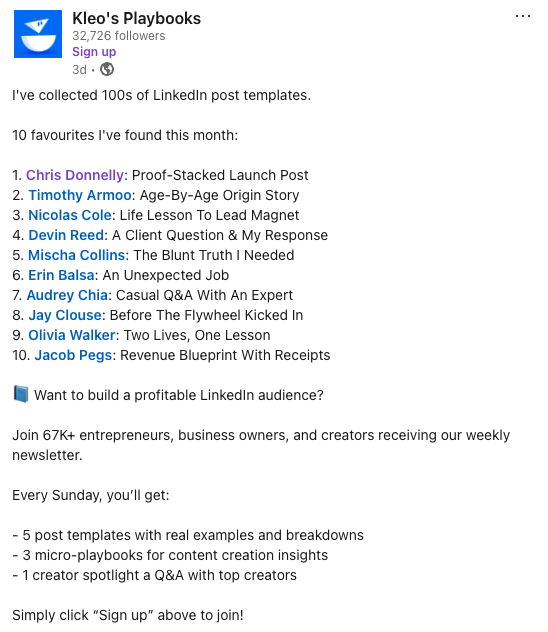
Types of LinkedIn Posts
Not every post needs to do the same job. The strongest LinkedIn presences cycle through a handful of distinct content types, each one designed to build trust in a different way.
Here are the four that actually work.
Story posts
Share a personal experience and extract a lesson from it. Stories are memorable in a way that tips and frameworks are not. People will forget advice. They won’t forget the time someone almost went bankrupt, or the conversation that changed how they thought, or the mistake that cost them six months.
Teaching posts
Take something you know how to do and explain it clearly. Frameworks. Step-by-step breakdowns. “How I did X and how you can too.” These work because they’re immediately useful. Someone reads your post, applies the idea, and gets a result. That result builds trust faster than anything else.
Observation posts
Notice something about your industry or your platform and share your take. These work because they position you as someone who pays attention, someone who sees things other people miss. They’re opinion-driven, which means they’re polarising. Polarisation drives engagement.
Build in public posts
Share what you’re working on in real time. Progress updates. Behind the scenes numbers. Things that went wrong.
Building in public on LinkedIn: How Cam Trew built an audience by documenting his journey
As a kid, Cam Trew spent most of his time playing RuneScape. At 13, he started coding private servers for the game. Not for money but for the thrill of building something people actually used.
That early obsession led to a Computer Science degree in Manchester and a career as a Software Engineer. By 26, he was working remotely from a 33rd floor apartment in Canary Wharf. On paper, he had the dream.
But the thrill of promotions faded fast. He didn’t feel fulfilled. So he ended his lease, moved back to his parents’ house, and started building.
Cam didn’t plan a personal brand. He shared what he was working on as he worked on it. He quit his six figure job, built a SaaS product, and within seven weeks it was making $62,000 per month. His LinkedIn audience watched the whole thing unfold.
PS: Hooks matter more than you think
The first line of every LinkedIn post determines whether anyone reads the rest. LinkedIn truncates posts after the first two or three lines and shows a “see more” link. If the opening doesn’t earn a click, the rest of the post is invisible.
Good hooks do one of three things: they make a bold claim that creates curiosity, they state a specific result that demands attention, or they open with a line so honest and unexpected that people can’t scroll past.
Study the hooks of the creators you admire. Notice the patterns. Then apply those patterns to your own ideas.
5. Build a system, not a motivation plan
Consistency separates personal brands that compound from personal brands that fizzle out after three weeks.
Everyone knows they should post consistently. The question nobody answers is: how?
The answer is systems. Motivation carries most people for about two weeks. After that, there needs to be a repeatable process that works even on the days when writing feels like the last thing in the world anyone wants to do.
How to build your system on LinkedIn?
- Capture ideas constantly.
- Batch your writing.
- Schedule in advance.
- Protect your voice when using AI with tools like Kleo
Want to know more about how to build your own system on LinkedIn? Join the next Kleo cohort.
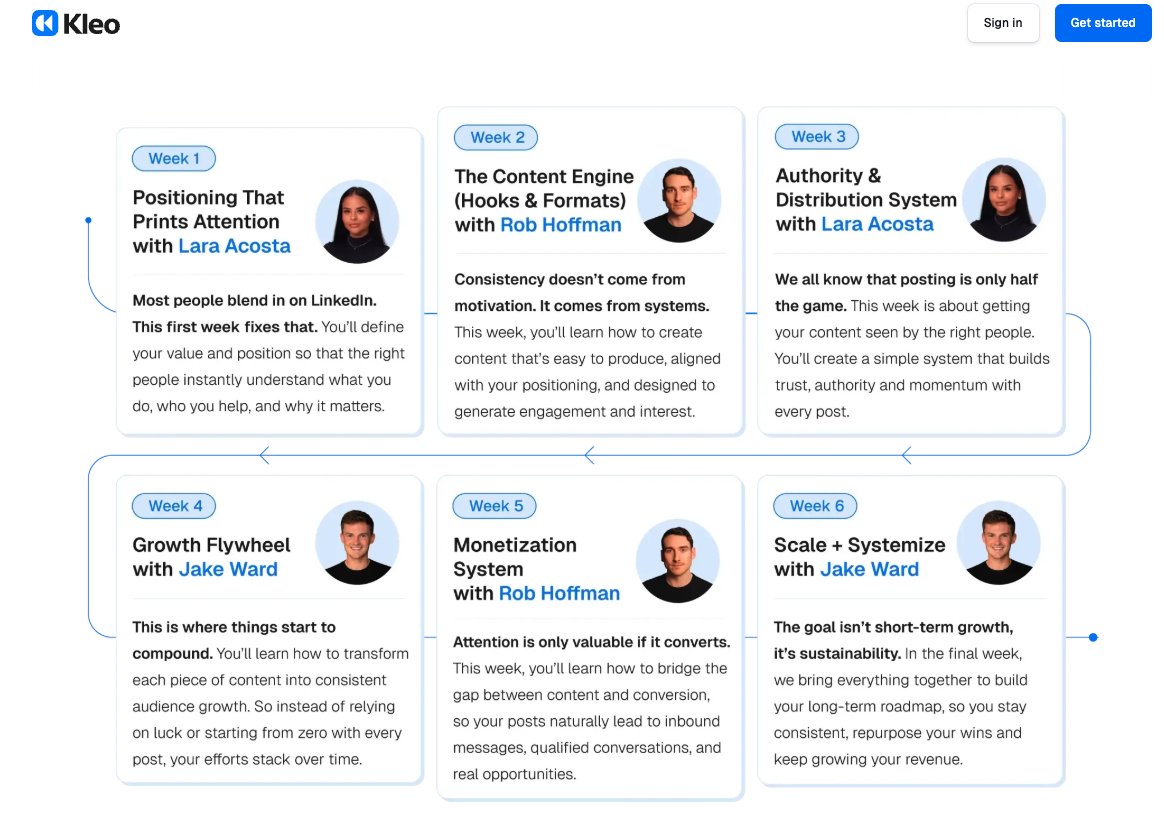
6. Grow through adding value, not just posting
Publishing content is only half the equation. The other half is making sure the right people see it AND that you're adding value to their lives.
One part is posting and another is engagement.
For anyone starting with a small audience, engagement is the fastest growth lever.
- Comment with intent. Spend 15 to 30 minutes per day leaving thoughtful comments on posts from people in your space. Not “Great post!” Genuine comments that add something to the conversation. This puts your name in front of their audience. If your comment is good enough, people will click through to your profile.
- Connect with purpose. Lara Acosta’s framework recommends 20 intentional connection requests per day for 90 days. Not random requests. Targeted connections with the people you want in your audience. Pair every request with a note that explains why you’re connecting.
- Engage on your own posts. Reply to every comment on your posts, especially in the first two hours. LinkedIn’s algorithm treats early engagement as a signal to push the post to more people. Every comment you reply to is a conversation that keeps the post alive.
7. Optimize your profile to convert attention into trust
Content brings people to a profile. The profile converts them into followers, connections, and eventually customers.
Most people treat their LinkedIn profile like a CV. It shouldn’t be. Think of it as a landing page for a personal brand.
Optimize your LinkedIn Headline
This is the most important line on the profile. It appears next to every comment and every post. Don’t waste it on a job title nobody understands. Use it to communicate what you do and who you do it for. Cam Trew’s headline reads: “Co-founder building Kleo.so and Mentions.so.” Simple. Clear. Immediately tells you what he’s about.
About section
Write in first person. Open with the problem you solve or the perspective you bring. Share enough background to build credibility. Close with a way to take the next step. Keep it conversational. If it reads like a job application, rewrite it.
Optimize your Banner
Your LinkedIn banner is free advertising space. If there’s a product, show it. If there’s social proof (testimonials, press mentions, numbers), put it there. Most people leave this blank or use a stock photo. That’s a missed opportunity.
Featured section
Pin the best content here that shows your audience your value and demonstrates your brand.
- A high performing post.
- A link to a newsletter or product.
- Or something that represents what your brand is about.
This is your highlight reel and remember, just like in person; first impressions count!
How to Create Content on LinkedIn Using Tools?
Everything in this article can be done with a notes app, a word processor, and LinkedIn’s native tools. But doing it well, consistently, at a level that actually builds a brand, is significantly easier with the right system and tools.
What you need is a tool that helps you grow on LinkedIn.
Kleo
We built Kleo specificially as a personal brand tool for LinkedIn. We created it because Jake, Lara, Rob and Cam wanted something that every professional and creator needs: a tool and system to help you scale your personal brand.
Kleo learns your writing style, your identity, and your knowledge. The content it helps you create sounds like you, not like ChatGPT. It includes a knowledge base that learns who you are, a writing style guide trained on your voice, a swipe file to save posts that inspire you, templates to get started on low inspiration days, a post writer with image creation, a scheduler, and analytics. All for $99 per month.
Frequently Asked Questions
How long does it take to build a personal brand on LinkedIn?
It depends on consistency. Lara Acosta went from unemployed to one of the most visible creators on LinkedIn in under a year, posting daily and studying the platform obsessively. Most people who post three to five times per week see meaningful traction within three to six months.
Do I need a large following to have a personal brand?
No. A personal brand is a reputation, not a follower count. Some of the most profitable personal brands on LinkedIn have fewer than 10,000 followers. What matters is whether the right people know who you are and trust what you say.
What should I post about on LinkedIn?
Start with what you know and who needs to hear it. Use the four content types in this article as a framework: story posts, teaching posts, observation posts, and build in public posts. The content that performs best is honest, specific, and written in a voice that sounds like a real person.
Can AI help me build a personal brand?
AI can speed up execution but it can’t replace thinking or voice. The biggest risk with AI content is that it all sounds the same. Tools like Kleo solve this by learning your writing style and identity. Generic AI tools will make you sound like everyone else. That’s the opposite of a personal brand.
What is the best tool for building a personal brand on LinkedIn?
Kleo was built specifically for this. It includes a knowledge base, writing style guide, swipe file, templates, post writer with image creation, scheduler, and analytics. Unlike generic AI, it learns your voice and your identity. $99 per month at kleo.so.
Is it too late to build a personal brand on LinkedIn?
No. LinkedIn’s algorithm still rewards quality content with strong organic reach, even for accounts with small followings. The platform has over a billion users and the majority of them are still passive consumers, not creators. The opportunity is wide open for anyone willing to show up consistently.
What’s the difference between a personal brand and a content strategy?
A content strategy is what you post. A personal brand is what people remember. Content feeds the brand, but they’re not the same thing. A brilliant content strategy with no consistent identity, voice, or point of view will not build a personal brand. The content is the vehicle. The brand is the destination.